How a Food Daily Log Book Becomes the Backbone of Your Nutrition Planning System
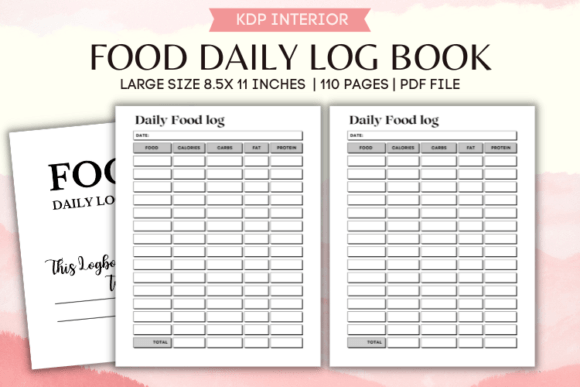
Most people approach food tracking the wrong way. They download an app, use it for three days, miss a meal entry, and abandon the whole effort by Thursday. The problem isn't motivation—it's the absence of a physical, intentional tool that forces you to slow down and engage with what you're actually consuming. The Food Daily Log Book solves this by giving you a dedicated space to document every meal, snack, and glass of water across 110 pages, in a generous 8.5x11 inch format that doesn't constrain your thinking or your handwriting.
This isn't just a notebook. It's a planning instrument that sits at the intersection of self-observation and behavior change. When you commit to logging your intake on paper, you're building a feedback loop that no automated tracker can replicate. The PDF format means you can print it fresh whenever you need a new cycle, or keep a digital copy for reference while using a printed version for daily entries.
Where the Food Daily Log Book Fits in a Broader Health Workflow
Think of your health routine as having three distinct phases: planning, execution, and review. Most tools only address one of these. The Food Daily Log Book supports all three. Before your week begins, you can use the log to sketch out intended meals. During the week, you record what actually happens—because plans rarely survive contact with reality. After the week, you have a complete dataset to review patterns you'd otherwise miss.
For professionals juggling deadlines, creators managing projects, or entrepreneurs building businesses, nutritional consistency often gets sacrificed first. The log book acts as a non-negotiable checkpoint. It takes less than five minutes to fill out after a meal, but those five minutes prevent the mindless eating that accumulates when you're focused on work. The physical act of writing also engages your brain differently than tapping a screen, strengthening the commitment to your choices.
Pre-Project Preparation: Setting Up Your Tracking Foundation
Before you write a single food entry, define what you're actually tracking and why. The Food Daily Log Book gives you 110 pages of structured space, but how you use them depends on your goals. Someone aiming for weight management will focus on portion sizes and meal timing. An athlete in training will track macronutrient balance and hydration more closely. A person managing digestive issues might add notes about how they felt after each meal.
During this preparation phase, decide on your tracking categories. The log book accommodates meals, snacks, and water intake as its core fields, but you can extend that framework. Consider adding a column for energy levels, a section for cravings, or a space to note the context of each meal—were you eating alone at your desk, or with family at the table? Context matters more than most people realize.
The Daily Execution Loop
Recording meals after you eat them is the minimum. Using the log book effectively means integrating it into a small decision cycle that runs throughout your day. Before you eat, glance at what you've already logged. Ask yourself: what's missing? Am I short on vegetables? Have I had enough water? The log becomes a running dashboard, not a post-hoc report card.
The Food Daily Log Book's large 8.5x11 inch pages mean you're not cramming information into tiny cells. You have room to write meal descriptions, note portion sizes in meaningful terms (a fist-sized serving of rice, rather than an abstract gram count), and add the kind of qualitative detail that makes review sessions productive. A log entry that reads "chicken salad" tells you nothing. One that reads "grilled chicken breast, mixed greens, olive oil dressing, felt full but not heavy" gives you actionable data.
Practical Integration with Other Tools and Resources
The Food Daily Log Book doesn't have to work alone. It pairs effectively with digital tools, nutrition databases, and professional guidance in ways that paper-only or app-only approaches can't match. You might use a calorie-tracking app to look up nutritional information, then record the meaningful summary in your log book. This hybrid approach gives you the accuracy of digital data with the retention and reflection benefits of handwriting.
If you work with a dietitian, nutritionist, or personal trainer, the log book becomes a communication tool. Bring it to appointments. Let them see the patterns you've documented—including the messy days, the skipped entries, the honest notes about late-night snacking. Professionals can work with real data. They can't work with sanitized summaries or memory-based approximations.
Compatibility with Meal Planning and Grocery Systems
A food log that only looks backward misses half its potential. Use the Food Daily Log Book as part of a forward-looking system. Before you grocery shop, review the past week's entries. Which meals worked? Which ones left you hungry two hours later? Which required ingredients you didn't have on hand? This review directly informs your shopping list and meal prep decisions.
For busy adults managing households, the log book can also serve as a family reference point. If multiple people are tracking, each person can maintain their own printed copy from the PDF file. The format is consistent, which means everyone speaks the same tracking language, even if their goals differ. A partner training for a marathon and a partner managing blood sugar can use identical log structures for entirely different purposes.
Organization and Long-Term Consistency Strategies
The 110-page count in the Food Daily Log Book is intentional. At roughly one page per day, you're looking at about three and a half months of tracking—enough time to establish a habit, see meaningful patterns, and make adjustments that stick. Short-term tracking produces short-term insights. Three months gives you enough data to distinguish between a fluke and a trend.
To maintain consistency across that span, anchor your logging to existing routines rather than trying to create new ones. Log breakfast while your coffee brews. Log lunch before you clear your plate. Log dinner as part of your evening wind-down. The log book fits into the gaps between activities rather than demanding its own dedicated time block. The PDF format also means you can reprint specific pages if you need a fresh start without abandoning your accumulated data.
Handling Incomplete Days and Imperfect Entries
Perfectionism kills food logs faster than anything else. You'll have days where you forget to log afternoon snacks. You'll have restaurant meals where you can only approximate what you ate. The Food Daily Log Book accommodates this reality because it's not algorithmic—it doesn't reject partial data. An entry that says "ate out, Thai food, reasonable portions" is better than a blank page. Write what you remember. Move forward. The log's value accumulates from consistency, not perfection.
Some of the most useful data comes from incomplete days. A gap in logging often correlates with a gap in mindful eating. When you review and notice Wednesday is half-blank, you can reconstruct what happened: a surprise meeting that ran through lunch, followed by grabbing whatever was available. That pattern recognition is exactly what the log book facilitates, and it's far more visible on a physical page than in an app's data visualization.
Quality Control and Pattern Recognition During Review
Reviewing your Food Daily Log Book isn't about judgment—it's about observation. Set aside fifteen minutes once a week to flip through the past seven days. Look for clusters: do certain days consistently show lower water intake? Are afternoon energy slumps preceded by specific lunch patterns? Does your weekend logging look completely different from your weekday logging?
Use a highlighter or colored pen to mark patterns as you find them. The 8.5x11 inch format gives you margin space for annotations. Write your observations directly on the page: "felt great this day—note breakfast composition" or "three days in a row without vegetables at lunch." These marginal notes turn a simple record into a working document that actively guides your future choices.
Using the Log Book During Transitions and High-Stress Periods
Life doesn't pause for your tracking goals. Travel, project deadlines, family obligations, and seasonal changes all disrupt eating patterns. The Food Daily Log Book becomes especially valuable during these periods. When your routine breaks, your log provides a tether to your intentions. Even minimal entries during a chaotic week preserve continuity and make it easier to resume full tracking when things settle.
For professionals who travel frequently, print relevant pages from the PDF before you leave. Pack them with your toiletries—a physical reminder that you intend to maintain awareness of your eating, even when you're eating at airports and client dinners. The log doesn't judge context. It simply records it, and that record helps you make slightly better choices amid constrained options.
Building a Sustainable Relationship with Your Tracking Practice
The Food Daily Log Book works best when you treat it as a tool for self-understanding rather than self-policing. Tracking that feels punitive won't last. Tracking that feels investigative will. Approach each entry with curiosity. What did I actually eat today? How did it affect me? What would I do differently tomorrow? These questions transform logging from a chore into a useful daily ritual.
After you fill your 110 pages, you'll have something no app can give you: a physical artifact of your effort. You can hold three months of attention and intention in your hands. That's powerful for motivation and for practical analysis. Compare your first week to your last week. Notice where your handwriting changes, where entries become more detailed, where your food choices shift in response to your own observations.
The PDF delivery means you can start again immediately, or share the format with someone else who noticed your consistency and asked what you were doing. The log book becomes a replicable system, not a one-time purchase. Each new cycle builds on the insights from the last, creating a compounding effect that transforms how you relate to food, planning, and the daily decisions that shape your health.
Why Physical Tracking Outperforms Digital-Only Approaches Over Time
Apps notify you. Paper waits for you. That distinction matters more than it seems. A Food Daily Log Book requires your active participation. You have to remember to open it, pick up a pen, and write. That small barrier is actually a feature—it selects for genuine intention. People who sustain paper logs tend to be people who have clarified their reasons for tracking in the first place. The log doesn't replace motivation; it gives motivation a structure.
The 8.5x11 inch page size also matters for long-term usability. Smaller journals constrain your writing and discourage detail. Pocket-sized trackers work for quick checkmarks but fail when you want to write a sentence about how a meal made you feel or note a recipe you want to repeat. Full-sized pages invite the kind of reflection that produces real insight. You have space to think on paper, and that thinking compounds across 110 pages into a meaningful body of personal data.
Water intake tracking, often neglected in digital tools that focus exclusively on calories, gets equal billing in this log book. Hydration affects energy, cognition, digestion, and appetite regulation. By recording water alongside food, you start to notice correlations: the afternoon headache that's really dehydration, the snack craving that's actually thirst. These connections are easy to miss when tracking systems don't present them side by side.
The Food Daily Log Book ultimately functions as a decision-support tool. It doesn't make choices for you, but it makes your existing choices visible in a way that guides better ones. Every page you fill represents a day you paid attention. Across 110 pages, that attention accumulates into lasting change—not through motivation or willpower, but through the quiet, persistent practice of writing down what you eat and learning from what you see.