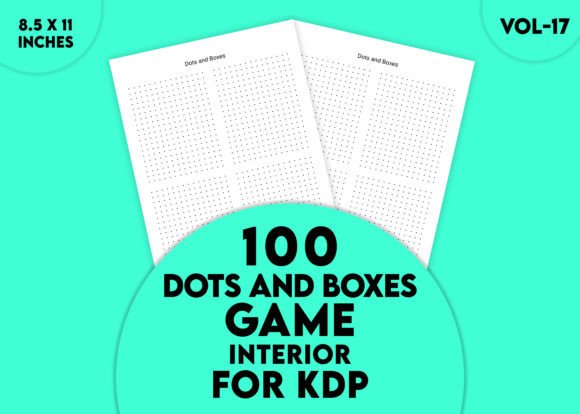
Dots and Boxes Interior for KDP Vol-17: Your Complete Activity Book Blueprint
There is something quietly magnetic about a game that fits on a single sheet of paper yet holds attention for an hour. If you have ever watched two people hunched over a grid of dots, drawing careful lines and circling completed squares with quiet triumph, you already understand the enduring appeal. The Dots and Boxes Interior for KDP Vol-17 captures exactly that timeless energy and transforms it into a polished, print-ready resource built for modern self-publishers, educators, and creative entrepreneurs.
Whether you are assembling a quiet-time activity book, designing a classroom resource, or building a low-content publishing catalog, the interior file you choose matters more than most people realize. A poorly formatted grid frustrates players. Inconsistent spacing makes a book feel amateurish. The Dots and Boxes Interior for KDP Vol-17 eliminates those headaches by delivering a meticulously structured template that respects both the player experience and the publisher's workflow.
What Makes a Dots and Boxes Game Work on Paper
Before diving into the specifics of this volume, it helps to understand the mechanics that make a print-based Dots and Boxes game satisfying. The premise is elegantly simple: two players alternate turns, each drawing a single horizontal or vertical line between two adjacent dots. When a player completes the fourth side of a square, they claim that box—typically marking it with their initial or a designated color—and earn an extra turn. The game concludes when no lines remain to be drawn. The player with the most claimed boxes wins.
This straightforward rule set belies a surprisingly deep strategic layer. Experienced players learn to avoid creating the third side of any box, lest they hand their opponent a cascade of captures. Chain reactions, sacrificial lines, and endgame counting all come into play. A well-designed interior supports this cognitive engagement by providing crisp, uniformly spaced dot grids that make every move visually clear.
Unpacking the Dots and Boxes Interior for KDP Vol-17
This particular volume arrives as an editable PDF file, sized at a generous 8.5 by 11 inches—the standard letter dimension that dominates the North American print market and fits comfortably on most home printers. With 100 pages of content and four distinct game boards per page, the book yields 400 individual game sessions before it is exhausted. For a family on a road trip, that is months of entertainment. For a classroom teacher, that is a full semester of rainy-day recess activities.
The interior layout follows a clean, distraction-free philosophy. Each page presents four clearly separated dot grids, giving players ample room to draw lines without crowding. The margins are generous enough to accommodate binding—whether spiral, perfect-bound, or stapled—without cutting into the playing area. This attention to trim and bleed considerations signals that the designer understands real-world printing constraints.
Key Specifications at a Glance
- Total page count: 100 pages of ready-to-play dot grids
- Game density: 4 complete Dots and Boxes boards per page
- Format: Editable PDF file compatible with standard software
- Page dimensions: 8.5 × 11 inches, the industry-standard letter size
- Total games: 400 individual play sessions
Why Page Size and Game Count Matter for KDP Publishing
Amazon's Kindle Direct Publishing platform has specific requirements for print books, and the 8.5 by 11-inch format sits squarely within accepted trim sizes. This means the Dots and Boxes Interior for KDP Vol-17 can be uploaded directly without resizing or reformatting. The 100-page count also hits a sweet spot for KDP economics: thick enough to display a visible spine for retail shelving, thin enough to keep printing costs reasonable and royalty margins healthy.
For publishers who plan to expand their catalog, this volume format establishes a consistent template. When you release additional activity books—word searches, sudoku collections, mazes—maintaining the same trim size creates a cohesive brand appearance. Customers who enjoy one book recognize the format and feel confident purchasing others.
Who Benefits Most from This Interior
While the product is straightforward, the audience segments it serves are remarkably diverse:
- KDP self-publishers seeking turnkey low-content interiors that require minimal customization before going live
- Teachers and educational professionals building logic and strategy resources for students from elementary through high school
- Therapists and counselors incorporating non-verbal, turn-taking activities into sessions that benefit from structured play
- Senior activity coordinators designing cognitive engagement materials for assisted living and community centers
- Parents and caregivers assembling travel-friendly entertainment that does not rely on screens or batteries
- Party planners and event hosts creating custom activity booklets for weddings, reunions, or corporate gatherings
Strategic Depth Hidden in Simple Grids
Many dismiss Dots and Boxes as a children's pastime, yet the game has attracted serious mathematical analysis. The combinatorial game theory underlying each move connects to broader concepts in graph theory and positional strategy. A standard 6×6 dot grid, for example, contains 25 potential boxes and forces players to navigate branching decision trees that grow exponentially with each move.
The Dots and Boxes Interior for KDP Vol-17 respects this intellectual heritage by providing grids that are neither trivially small nor unwieldy large. The boards are calibrated to deliver satisfying 10-to-15-minute games—long enough for strategic thinking to emerge, short enough to hold attention and encourage rematches. This duration sweet spot is one reason the game has persisted across generations while other pencil-and-paper diversions have faded.
The Editable PDF Advantage
A static JPEG or flattened PNG limits what a publisher can achieve. The editable PDF format of this interior unlocks significant flexibility. Want to add a header with your brand name on every page? You can. Need to insert page numbers in a specific font that matches your cover design? Straightforward. Prefer to include a brief rules summary or strategy tip on empty pages or in margin spaces? The editable structure accommodates those customizations without requiring a complete redesign.
This flexibility extends to hybrid use cases. A math tutor might overlay numbered coordinates onto the dot grids, transforming each game into a gentle introduction to Cartesian planes. A language instructor could label dots with vocabulary words, prompting students to form sentences that connect terms before claiming a square. The editable foundation supports creative adaptations that a locked interior file would preclude.
Print Quality and the 8.5 × 11 Inch Standard
Letter-sized paper remains the default for printers across North America and is widely available internationally. The 8.5 by 11-inch dimensions used in the Dots and Boxes Interior for KDP Vol-17 ensure that anyone purchasing the resulting book—or printing it at home—can do so without hunting for specialty paper stock. This universality translates to broader market reach and fewer customer service inquiries about printing compatibility.
From a production standpoint, the 100-page count also means the book spine will be approximately 0.25 inches thick when printed on standard white paper, providing enough surface area for a readable title. Books thinner than 80 pages often struggle to display spine text legibly, which can hurt brick-and-mortar shelf presence if you pursue expanded distribution channels beyond Amazon.
Considerations Before Publishing
While this interior file dramatically simplifies the publishing process, a thoughtful publisher will still take care with a few surrounding elements. The cover design should clearly communicate the book's purpose at thumbnail size, since many KDP browsing decisions happen on mobile devices. Including the phrase "400 Games" or "100 Pages of Fun" prominently on the front cover can improve conversion rates by immediately signaling value.
The book description on your product page should use keywords naturally. Phrases like "two-player strategy game book," "pen and paper activity," "travel games for kids," and "classroom brain break activities" help surface your listing to relevant shoppers without resorting to keyword stuffing. Mentioning the Dots and Boxes Interior for KDP Vol-17 quality in your description's editorial section can also reassure buyers that the interior is professionally formatted.
Comparing Interior Options on the Market
Not all game book interiors are created equal. Some competing products skimp on page count, offering 50 or 60 pages at a similar price point. Others cram too many games onto each page, shrinking grids to the point where drawing lines becomes fiddly and frustrating. A few neglect to provide editable source files, locking buyers into whatever layout shipped with the original PDF.
This volume's combination of 100 pages, four well-spaced games per sheet, letter-sized dimensions, and an editable format positions it as a premium option for serious publishers. The total of 400 games provides genuine staying power—a purchaser who plays one game per day would need more than a year to exhaust the book.
Practical Ideas for Different Audiences
A school counselor might keep copies on hand for students who benefit from structured social interaction during lunch periods. The turn-taking mechanics naturally teach patience and fair play, while the strategic element engages analytical thinking without feeling like academic work.
A retirement community could incorporate the book into intergenerational programming, where visiting grandchildren and residents compete on equal footing—the game's simplicity bridging age gaps effortlessly. The large 8.5 by 11-inch format makes dots easy to see for players with reduced visual acuity.
Entrepreneurial publishers might bundle this interior with companion volumes—a travel-sized edition at 6 by 9 inches, or a "Dots and Boxes Tournament" version with scoring sheets and bracket pages. The editable PDF serves as a foundation that can spawn multiple derivative products, each targeting a distinct niche within the broader puzzle and game book market.
Making the Most of Your Licensed Interior
Once you acquire the Dots and Boxes Interior for KDP Vol-17, the path to publication follows a logical sequence. Verify that all 100 pages render correctly in your PDF viewer. Add any desired customizations—branding, page numbers, optional instructions. Design a cover that aligns with your target audience, whether that means bright, playful colors for children or clean, minimalist typography for an adult strategy audience. Upload to KDP, order a proof copy, and review the physical book before hitting publish.
That final proofing step matters. Screen renderings cannot fully convey how a dot grid feels under a pencil, whether the paper's opacity prevents show-through, or how the binding affects the book's ability to lie flat during play. A proof copy costs a few dollars and a few days of shipping time, and it is almost always worth the investment.
The game of Dots and Boxes has been played for well over a century, appearing under various names—La Pipopipette in France, Paddocks in some English-speaking regions, and simply Squares among countless schoolchildren. The Dots and Boxes Interior for KDP Vol-17 carries that lineage forward in a format purpose-built for today's independent publishing landscape, offering a bridge between a cherished analog pastime and the digital tools that bring it to new audiences worldwide.