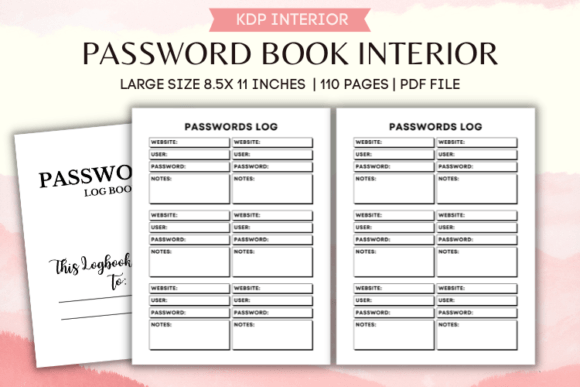
Password Book Interior File: A Practical Approach to Keeping Digital Life Under Control
There is something quietly reassuring about having everything in one place. In a world where every website, app, and service demands another set of credentials, the mental load of remembering it all can become surprisingly heavy. That is where the Password Book Interior File steps in, not as a digital tool, but as a deliberately analog companion that brings a different kind of order to a chaotic part of modern life.
The concept is simple. A 110-page PDF file, formatted at a generous 8.5x11 inches, designed with clear sections for website names, usernames, and passwords. You download it, you print it, and suddenly you have a physical logbook that sits on your desk, tucks into a drawer, or slides onto a bookshelf. It does not sync, it does not beep, and it does not require a master password to access. That simplicity is precisely why so many people find it useful.
When Digital Overload Makes an Analog Solution Feel Right
Think about the number of times you have clicked "forgot password" in the last six months. For many adults, that small act of resetting access has become a recurring ritual, one that eats away minutes and patience. A Password Book Interior File changes that rhythm by giving you a tangible reference that never logs you out.
Consider the household where multiple family members share certain accounts. Streaming services, utility portals, insurance logins, community association websites. One person typically manages them all, and if that person is unavailable, the rest of the household is locked out. A printed password book becomes a shared resource, kept in a known location, that bridges that gap without requiring technical knowledge or password-sharing apps.
There is also the quiet benefit of reducing what psychologists call cognitive switching. Every time you stop a task to hunt for a login, your brain shifts context. Those micro-interruptions accumulate. Flipping open a physical book can be faster and less disruptive than unlocking a phone, opening an app, authenticating, and searching. It is a small friction reduction that, over weeks and months, genuinely adds up.
Who Finds the Most Value in a Printable Password Organizer
The audience for something like this is broader than it first appears. It is not only for people who distrust technology or consider themselves non-technical. In fact, some of the most enthusiastic users are highly technical individuals who understand that no digital system is perfectly immune to failure, corruption, or lockout.
Small business owners often manage dozens of vendor portals, banking sites, tax platforms, and service accounts. The credentials multiply quickly, and sharing them with a bookkeeper or assistant securely can be awkward through digital means. A clean, alphabetized physical logbook offers a straightforward reference that can be handed over or stored in a locked office drawer.
Freelancers and solopreneurs who juggle client accounts, subscription tools, and platform dashboards also benefit. When a client calls and needs something updated, scrambling to find the login can feel unprofessional. Having a dedicated book where client-related credentials are organized separately brings a sense of control that is hard to replicate with browser-saved passwords alone.
Older adults who did not grow up with password managers often prefer the familiarity of pen and paper. The Password Book Interior File respects that preference by offering large, clear print in a format that is easy on the eyes. The 8.5x11 inch size leaves plenty of room for neat handwriting, which matters when vision or dexterity are considerations.
Unexpected Places Where a Physical Password Book Fits
There are scenarios that rarely come up in conversations about digital security but are entirely real. Think about a family cabin or vacation home where internet is spotty at best. A printed book of essential logins for property management, utilities, and local service accounts can live in that space permanently, independent of whether a phone has signal or a laptop has charge.
Emergency planning is another area where a password logbook proves its worth. In the event of a health crisis, a designated family member may need access to insurance accounts, bill payment portals, and communication channels. Relying on a digital vault that requires a master password someone may not know—or biometric access that is unavailable—creates unnecessary barriers during already stressful times. A clearly maintained physical book, stored securely, becomes a thoughtful part of preparedness.
Teachers and school administrators managing classroom tools, educational subscriptions, and gradebook platforms often accumulate a surprising number of logins. A shared department binder built from a printable interior file allows multiple educators to find what they need without endless email chains asking for the same credentials over and over.
More Than Just Website Names and Passwords
While the core structure of the interior file focuses on website, username, and password fields, creative users extend its usefulness far beyond that. Some add a column for security question answers, knowing that those random prompts—your first pet's name, the street you grew up on—are just as easy to forget. Others dedicate pages to software license keys, Wi-Fi network names and passwords for different locations, or even membership numbers for libraries, museums, and loyalty programs.
The flexibility of a blank, well-organized template means it can evolve with your needs. One section might track financial accounts, another might hold social media logins, and a completely separate area might be reserved for home-related information like the garage door programming code or the alarm system reset instructions. This adaptability is something app-based solutions often lack because they assume a fixed structure.
Privacy in a Physical Format: A Different Kind of Security
There is a genuine privacy advantage that comes with keeping credentials offline. No data breach of a cloud service can expose a handwritten book. No software vulnerability can silently extract its contents. For people who manage accounts that carry significant legal, financial, or personal weight, this air-gapped approach provides a layer of protection that complements, rather than replaces, digital security practices.
That said, a physical book requires physical protection. The same qualities that make it immune to remote attacks also make it vulnerable to local threats—loss, theft, fire, or simply being misplaced. Users who get the most out of their Password Book Interior File tend to treat it with the same care they would give a passport or a birth certificate. A fireproof safe, a locked filing cabinet, or even just a consistent habit of returning it to the same drawer after each use makes a meaningful difference.
Designing a System That Actually Gets Used
The success of any organizational tool depends less on its features and more on whether it fits naturally into daily habits. A password book only works if you update it, use it, and keep it accessible enough that it does not become a chore. The large format of this particular interior file helps because there is room to write clearly without cramping entries together.
Some people alphabetize their entries continuously. Others prefer grouping by category—financial, social, utilities, subscriptions. A few add color-coded tabs or highlighters to distinguish between personal and work accounts. The book does not enforce a system, which is exactly why people are more likely to stick with it. They shape it to their own logic rather than conforming to someone else's structure.
A common mistake is trying to use a small pocket notebook for this purpose. The pages fill up too quickly, the handwriting becomes illegible, and the book gets abandoned. The 110-page count here offers enough space for a robust collection of accounts without becoming unwieldy. It strikes a balance between comprehensiveness and manageability.
Why a Printable File Makes Practical Sense
The fact that this comes as a PDF file rather than a bound book changes how people use it. You can print only the pages you need. You can reprint a fresh copy when one becomes full or outdated. You can print extras for family members or backup copies stored in different locations. You can even take it to a print shop and have it spiral-bound for durability if that suits your preferences.
For those who prefer a more customized experience, printing on thicker paper improves longevity. Adding a cover page with a generic label like "Household Reference" rather than "Passwords" adds a subtle layer of discretion if the book is kept on a shelf. Small adjustments like these come from understanding that security is as much about behavior and environment as it is about the tool itself.
Recognizing the Limits and Working With Them
An honest look at a password logbook means acknowledging what it does not do. It does not generate strong passwords. It does not alert you if a password has been reused across multiple sites, which is a common security weakness. It does not automatically fill in forms or sync across devices. These are not flaws; they are simply the nature of the form.
To address password strength, many users pair the logbook with a habit of generating passwords through a secondary method first, then recording them. Some keep a small note next to entries indicating when the password was last changed, creating a manual audit trail. These practices blend the reliability of paper with the discipline of good security hygiene.
Another limitation worth considering is that the book shows everything at a glance, which is both its strength and its risk. If left open on a desk during a gathering or visible during a video call, unintended exposure is possible. Awareness of that reality guides how people store, handle, and position the book in their daily environment.
Bringing a Sense of Calm to Something Unglamorous
Organizing passwords is not an exciting topic. It does not spark joy in the way a creative hobby or a home renovation might. But there is a quiet satisfaction in knowing that when you need to access something important, the information is exactly where you expect it to be. That reliability removes a low-grade stress that many people do not realize they have been carrying.
The Password Book Interior File serves that need without overcomplicating it. It does not ask for updates, it does not send notifications, and it does not try to upsell you on a premium tier. It simply provides a clean, spacious, printable template that you can make entirely your own. For adults navigating jobs, households, community responsibilities, and the endless stream of digital accounts that come with all of those roles, that kind of straightforward utility is quietly powerful.