Mission Statement Worksheet: A Practical Approach to Defining What Matters Most
A well-crafted mission statement brings direction to daily decisions and long-term plans. Yet for many people, the act of writing one feels abstract or intimidating. A Mission Statement Worksheet bridges that gap. It transforms a big-picture idea into a series of manageable steps, prompting you to reflect on values, purpose, and desired impact without getting lost in overthinking. Whether you’re shaping a personal mantra, a team’s shared direction, or the foundation of a small business, the right worksheet can make the process feel less like a writing assignment and more like an honest conversation with yourself.
What a Mission Statement Worksheet Actually Does
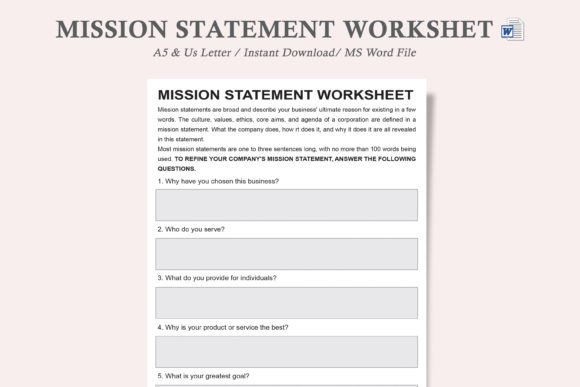
At its core, a mission statement worksheet is a structured document that asks specific questions to help you uncover why you do what you do. Rather than handing you a blank page, it guides you through prompts that explore your core beliefs, the people you want to serve, the change you aim to create, and the activities that align with those priorities. Some versions are a single page with carefully worded sentences to complete; others span multiple pages with room for deep reflection.
The best worksheets function as both a filter and a mirror. They help you sift through competing priorities and see your own motivations more clearly. A well-designed Mission Statement Worksheet doesn’t just produce a polished sentence—it also reveals the underlying reasoning, which can be just as valuable as the final statement itself.
How a Worksheet Stacks Up Against Templates, Builders, and Workbooks
The landscape of purpose-setting tools is broad, and understanding the differences can save you time and frustration. A mission statement template is typically a fill-in-the-blank format. It’s quick and formulaic, often useful for corporate branding exercises but sometimes too rigid for personal depth. A mission statement builder, often found online, walks you through a digital wizard, suggesting words and generating a polished phrase. This can be efficient, but you trade privacy and the deliberate slowness of handwriting for speed.
A mission statement workbook usually offers a more comprehensive journey—sometimes 20 pages or more of exercises, journaling prompts, and visioning activities. It’s ideal for an immersive weekend retreat, but it can feel overwhelming when you need a straightforward starting point. A mission statement exercise, on the other hand, might be a single thought experiment or a set of focused questions used in a workshop; it’s great for group settings but rarely provides a standalone record you can revisit.
A Mission Statement Worksheet sits in a practical middle ground. It’s more guided than a blank template, more concise than a full workbook, and more personal than a builder. The format encourages independence—you work at your own pace, with the option to scribble, erase, and rewrite without the constraints of a software interface.
Strengths That Go Beyond Convenience
One of the most underrated strengths of a well-designed worksheet is its reusability. Because it’s printable, you can return to it months or years later when your circumstances shift. Some versions are deliberately ink-friendly and minimalist, so printing a fresh copy doesn’t feel wasteful. This makes them appealing to both highly visual planners and those who simply want a clean, distraction-free experience.
Another strength is format flexibility. Many downloadable worksheet packages include multiple file types: PDFs for printing, JPEGs for integration into digital note-taking apps, and editable MS Word files for those who prefer typing directly. The option to choose between US letter and A5 sizes can be surprisingly valuable. A smaller A5 sheet fits neatly into a journal or planner, while a full-size US letter version can be pinned to a wall or slipped into a binder. This versatility means the same underlying framework can adapt to vastly different planning styles.
When a Printable Worksheet Outperforms a Digital Tool
There are specific situations where paper beats pixels. If you value privacy and want to explore raw, unfiltered thoughts without them being stored on a cloud server, a printed worksheet offers a safe, offline container. The tactile act of handwriting engages a different cognitive process—slower, more reflective, and often more honest. For a mission statement, which should be deeply personal, that physical connection can lead to language that feels authentic rather than auto-generated.
A printable worksheet is also ideal for team or family settings. You can print multiple copies and work side by side, then compare notes. There’s no need to share logins or worry about version history; everyone gets the same clean slate. This makes it easier to facilitate a guided discussion around purpose without technology becoming a barrier.
When You Might Need More Than a Worksheet
For all its advantages, a worksheet is not a replacement for deep facilitation or therapy. If you’re navigating a major life transition, rebuilding a fractured team identity, or uncovering purpose after trauma, a single-page worksheet may feel insufficient. In those cases, a more structured mission statement workbook with layered exercises or a professionally facilitated values clarification workshop could be a better fit. The workbook may help you unpack limiting beliefs that a shorter worksheet isn’t designed to address.
Similarly, if you need a mission statement that must align with complex regulatory or multi-stakeholder requirements—such as a nonprofit’s public charter—a worksheet can serve as an initial brainstorm tool, but the final language will likely require legal or board-level refinement. Recognizing these limits helps you use the worksheet for what it does well: generating clarity from raw thinking.
Values Clarification: The Engine Inside the Prompts
A mission statement that isn't rooted in real values often sounds hollow. That’s why many effective worksheets double as values clarification worksheets. They ask you to circle or rank words like independence, creativity, stability, compassion, growth, or justice. This seemingly simple exercise forces you to confront what you genuinely prioritize, not what sounds impressive. When you later draft your mission statement, it’s harder to slip into generic buzzwords because you’ve already anchored yourself in concrete values.
Some worksheets integrate this seamlessly by having you revisit your top three values and check whether your draft statement actually reflects them. This built-in consistency check is a practical shortcut that can prevent the all-too-common mistake of crafting a statement that looks good on paper but doesn’t resonate internally.
Realistic Examples Across Different Contexts
Consider a freelance designer who feels pulled in too many directions. She prints an A5 Mission Statement Worksheet and tucks it into her daily planner. The prompts guide her to identify that she values simplicity, client empowerment, and visual storytelling. Her draft mission becomes, “I help quiet brands find their loudest, clearest visual voice.” That statement now acts as a filter for which projects she says yes to.
In a small retail business, the owner prints several US letter copies and sits down with two key employees. They each fill out the worksheet independently, then compare their answers. The exercise reveals a mismatch: the owner prioritizes community connection, while the employees assumed the mission was purely profit-driven. The resulting conversation leads to a refined shared mission that improves morale and customer experience.
These scenarios highlight why a flexible format matters. The designer might benefit from the JPEG file to paste into a digital vision board, while the shop owner’s team might use the MS Word version to type and edit collaboratively before finalizing. The worksheet’s value isn’t just in the content of the prompts; it’s in how easily it fits into someone’s existing workflow.
What to Look for in a Downloadable Worksheet
When evaluating a Mission Statement Worksheet, practical details can make a significant difference. A package that includes both US letter and A5 PDFs immediately increases usability across different planning systems. Having the same worksheet in JPEG format means you can embed it into apps like Notability or GoodNotes if you prefer a tablet and stylus. The inclusion of an editable MS Word file is a bonus for those who think better at a keyboard or need to share a draft remotely with a coach or accountability partner.
Design matters, too. A minimalist, ink-friendly layout respects your attention budget and printer cartridges. Busy graphics or heavy background colors might look attractive on a screen but become distracting when you’re sitting with a pen, trying to think deeply. A clean, professional layout keeps the focus on your answers, not on the design.
Choosing the Right Approach for Your Clarity Journey
The decision to use a worksheet, a builder, a workbook, or a template ultimately depends on how you process information and what you plan to do with the result. If speed and a professionally polished phrase are your top goals, a digital builder may suffice, though at the cost of personal nuance. If you want a reflective, private, and reusable tool that you can tailor to your own handwriting or typing preferences, a printable Mission Statement Worksheet with multiple format options is difficult to beat.
Consider your environment as well. A worksheet that can be printed at home in either A5 or US letter dimensions adapts to how you work—whether you’re at a desk, on a train, or sitting in a quiet corner of a library. The ability to print a fresh page whenever you need a reset lowers the pressure; you’re free to scribble out drafts without worrying about getting it perfect the first time.
Clarity rarely arrives in a single flash of inspiration. It builds over time, through repetition and honest reflection. A carefully designed worksheet honors that reality by offering structure without rigidity, depth without overwhelm, and repeatability without waste. By choosing a tool that matches your style, you invest not only in a better mission statement but in a clearer understanding of yourself or your organization—and that understanding is what truly guides success.