Hard Mazes for Advanced Puzzlers Vol-6
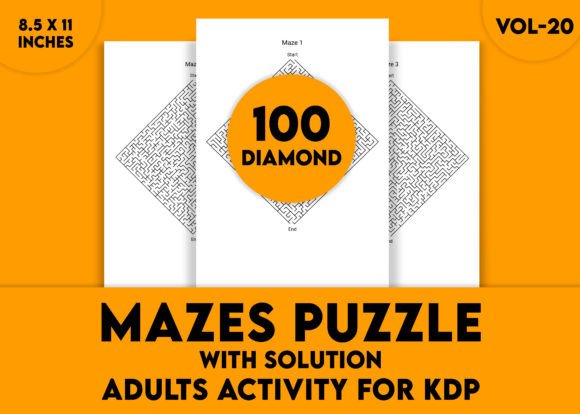
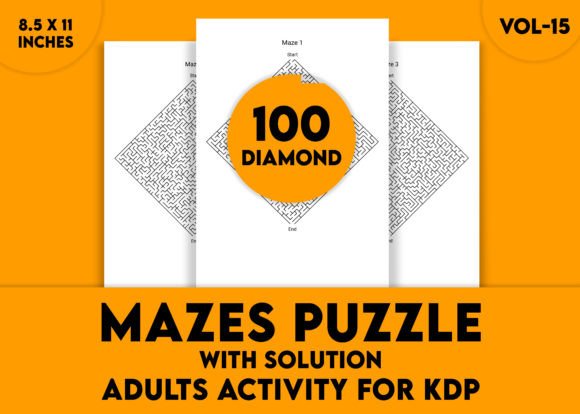
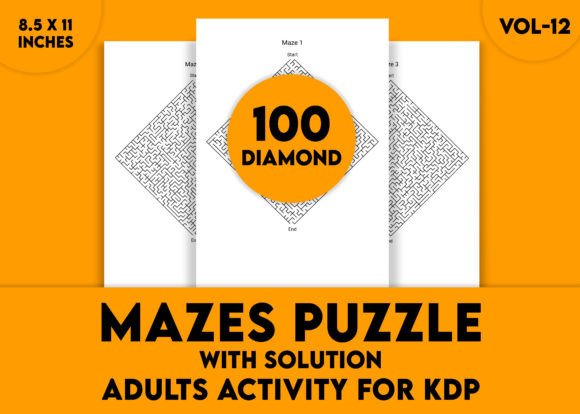
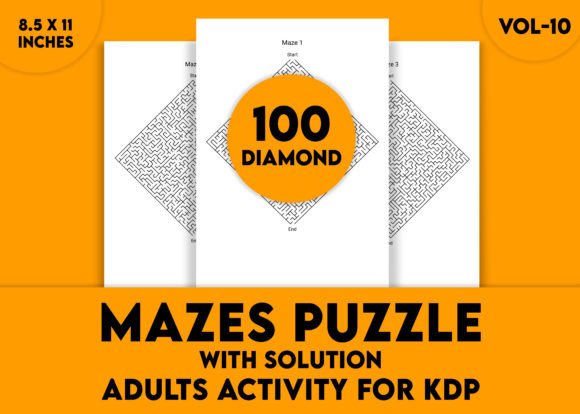
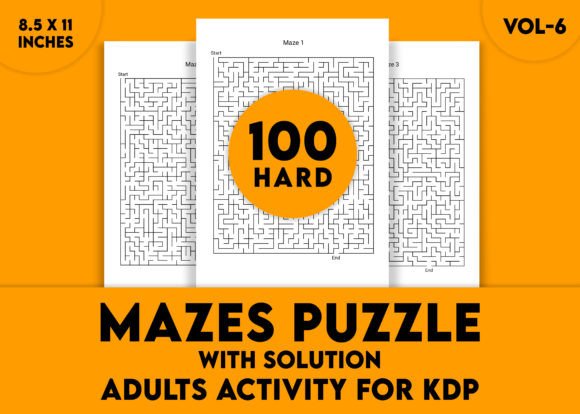
Some puzzles ask for patience. Others demand something closer to tenacity. Hard Mazes for Advanced Puzzlers Vol-6 falls squarely into the second category. This is not a casual activity book you flip through during a commercial break. It is a concentrated collection of 100 meticulously designed labyrinth puzzles, each one printed on its own 8.5x11 inch page, giving your eyes and your pencil the room they need to work through genuinely difficult paths. If you have been searching for a mental challenge that doesn't patronize you with simplicity, this volume delivers exactly that.
The format matters here as much as the puzzles themselves. A single rectangle per page means no visual clutter, no accidental glances at the next challenge while you're still deep in the current one. The large dimensions transform each maze from a cramped brainteaser into an expansive territory you can physically trace, annotate, and wrestle with. And when you finally reach the end—or need to check your logic—the solutions are thoughtfully organized four per page, keeping the reference section compact without sacrificing clarity.
Why Difficult Mazes Resonate with Adult Solvers
Complex maze solving occupies a strange and wonderful space between meditation and problem-solving. Unlike crossword puzzles that test vocabulary or Sudoku grids that lean on numerical patterns, a hard maze engages spatial reasoning, forward planning, and a quiet kind of persistence. You develop a rhythm: scan ahead, identify the branch that looks promising, trace it with your finger just above the paper, and either break through or backtrack. That cycle of hypothesis and revision mirrors the kind of thinking many professionals use daily.
For adults juggling demanding schedules, sitting down with a maze offers something rare—a single-focus activity. There are no notifications. No competing tabs. Just ink, paper, and a route waiting to be found. Studies in cognitive psychology have long suggested that activities combining visual scanning with fine motor engagement can strengthen working memory and attention control. When the mazes include multiple branches, looping paths, and deliberate dead ends, the brain gets a workout that feels far more substantial than ticking boxes on a digital app.
What Makes This Volume Different
The mazes in Hard Mazes for Advanced Puzzlers Vol-6 are not variations on a simple spiral. You can expect to encounter twisting corridors that fold back on themselves, obstacles placed strategically to break your momentum, and barriers that force you to reconsider entire sections of the puzzle. Some paths narrow into sequences where one wrong turn sends you deep into a loop, emerging only after you've traced the same perimeter three times from different angles.
The editable PDF format adds a layer of flexibility that printed books alone cannot offer. Publishers, educators, and content creators can adapt individual pages for workshops, newsletters, or activity bundles. Small business owners running coffee shops or bookstores might print and laminate a few selected mazes as tabletop activities that keep customers engaged longer. The reusability baked into a digital file expands the product's lifespan well beyond a single solve-and-discard cycle.
100 Mazes with Purposeful Variety
Quantity alone doesn't impress—it's the range of difficulty and design that keeps a collection like this compelling. Within those 100 puzzles, you'll encounter mazes that emphasize different cognitive demands. Some prioritize visual density, cramming paths so tightly that your eye struggles to separate viable routes from distractions. Others rely on symmetry to confuse your sense of direction, presenting mirrored layouts where left feels like right until you anchor yourself to a landmark. A few introduce barrier elements that block entire quadrants, requiring you to solve from the outside in rather than seeking the obvious straight line.
This variety prevents the solving experience from becoming mechanical. Each new page resets your approach, forcing you to abandon whatever strategy worked on the previous puzzle and invent a fresh one. That adaptability is precisely what makes maze-solving such an effective cognitive exercise for adults—it rewards flexible thinking over rote repetition.
Creative Applications Beyond Solo Solving
While working through the mazes alone is deeply satisfying, the collection opens up possibilities that go beyond personal enjoyment. Consider how different audiences might repurpose these designs in ways the original format doesn't dictate.
For Designers and Illustrators
The structural patterns within these mazes can serve as reference material for larger creative projects. A graphic designer working on a surrealist poster might study how the paths create negative space, borrowing that organic density for background textures. An illustrator developing a children's book with labyrinth themes could analyze how dead ends are disguised and how false exits are constructed, applying those principles to simplified versions suitable for younger readers.
Because the PDF is editable, extracting elements for study or transformation becomes straightforward. You can isolate specific maze sections, reverse-engineer the branching logic, and use those insights to generate original designs that share the same rigorous structure.
For Educators and Workshop Facilitators
Hard mazes aren't just for entertainment—they function as excellent tools for teaching persistence and strategic planning. A workshop on creative problem-solving might begin with a timed maze exercise, where participants must verbalize their thought process as they navigate. Hearing someone say "I'm going to try the upper path and if it dead-ends I'll mark it with an X" externalizes the kind of methodical thinking that applies to business strategy, project management, and design sprints.
Teachers working with advanced high school students or adult learners can use selected mazes as warm-up activities that prime the brain for complex tasks. The physical act of solving on paper—using a pencil, making deliberate marks—creates a tactile engagement that typing and clicking rarely replicate.
For Publishers and Content Entrepreneurs
The editable nature of the file turns Hard Mazes for Advanced Puzzlers Vol-6 into a content asset. Bloggers writing about cognitive health can include a sample maze as a downloadable lead magnet. Newsletter creators serving productivity-focused audiences might feature a weekly maze challenge that keeps subscribers opening emails. Small publishers producing activity books for niche markets can extract and reformat puzzles into themed collections—travel mazes, coffee-break mazes, or mazes paired with mindfulness prompts.
What matters is that the base material is strong enough to support these adaptations without feeling diluted. Because each maze was designed to challenge an advanced solver, the quality holds up even when repurposed across different formats and contexts.
Practical Tips for Getting the Most from Each Puzzle
Approaching a difficult maze without a system leads to frustration. Here are a few grounded methods that experienced solvers use, all of which apply directly to the puzzles in this collection.
- Scan the full layout first. Before putting pencil to paper, let your eyes travel the entire maze. Note where the start and end points sit in relation to each other. Identify obvious barriers—thick lines, shaded zones, or areas where paths vanish into tight clusters.
- Work backward from the goal. Sometimes the fastest route reveals itself when you trace from the finish toward the start. Advanced mazes often defend against forward-solving by placing traps exactly where your instinct wants to go.
- Mark dead ends clearly. Use a small dot or slash to label paths you've eliminated. When a maze loops back on itself, these visual markers prevent you from retesting the same failed route multiple times.
- Take breaks at natural checkpoints. If a puzzle spans a dense 8.5x11 inch page, solving it in one sitting might fatigue your spatial reasoning. Pause, look away, and return with fresh eyes—patterns tend to emerge after a reset.
- Use a removable pencil mark for tentative paths. Light lines let you explore a branch without committing, and they erase cleanly if you need to backtrack. This is especially useful on the larger page size where multiple attempts can coexist without turning the paper into a smudge.
Cognitive Benefits That Extend Beyond the Page
Solving hard mazes regularly doesn't just make you better at mazes. The underlying skills—visual scanning, pattern recognition, sequential planning, and error correction—transfer to tasks that demand sustained attention and mental flexibility. For marketers analyzing funnel paths, the ability to trace a user journey from entry to conversion shares structural DNA with navigating a complex labyrinth. For entrepreneurs evaluating strategic options, the habit of exploring branches methodically rather than committing impulsively mirrors the discipline maze-solving cultivates.
This is not to overstate the case. A puzzle book won't restructure your brain. But as a consistent practice woven into a weekly routine, it reinforces mental habits that serve you in more consequential contexts. The key is choosing challenges calibrated to your ability—and Hard Mazes for Advanced Puzzlers Vol-6 targets exactly that threshold where difficulty meets engagement without tipping into impossibility.
Who This Collection Suits Best
Puzzle enthusiasts who have outgrown beginner books will find the right level of resistance here. Freelancers and remote workers looking for a screen-free mental reset between deep-focus sessions can keep a printed page nearby, tackling it in five-minute increments. Hobbyists who collect puzzle formats—crosswords, cryptograms, logic grids—can add hard mazes to their rotation for variety that exercises a different cognitive muscle.
Gift-givers seeking something thoughtful for the adult who "already has everything" might pair the printed pages with a quality mechanical pencil and a flat-lay clipboard, creating a tactile kit that feels intentional. The large 8.5x11 inch format means the puzzles don't feel cramped or budget-printed—they sit comfortably on a desk, lap, or table.
Ultimately, a well-designed maze doesn't need to justify itself with grand promises. The reward is in the solving: the moment a path clicks into place, the quiet satisfaction of seeing the route you traced connect start to finish without a single wrong turn. Hard Mazes for Advanced Puzzlers Vol-6 offers that moment one hundred times over, each puzzle a fresh invitation to slow down, focus, and find your way.