My Quotable Kid: Recording the Laughter and Wonder of Growing Up
There is a particular kind of magic in the unfiltered words of a child. The way they mispronounce a difficult word until it becomes family lore, the unexpectedly profound observation about a cloud, or the hilarious logic that connects two completely unrelated ideas — these moments slip away as quickly as they arrive. My Quotable Kid steps into that fleeting space, offering a dedicated place to catch and keep what would otherwise vanish into the busy rhythm of daily life. At its heart, it is a thoughtfully designed journal that invites parents, grandparents, and caregivers to preserve the witty, sweet, and surprising things children say. More than a blank notebook, it provides a structured yet flexible framework that makes memory-keeping feel effortless.
The storefront that now houses this product greets visitors with a simple “Hi, welcome to the store,” a quiet entry point into a resource that has been carefully prepared for real-world use. The listing speaks directly to grown-ups who understand that children’s words carry an emotional weight far beyond their syllables — and who might also recognize the entrepreneurial potential tucked inside a ready-to-publish interior. Whether you are an exhausted parent laughing at a 6-year-old’s dinner-table philosophy, a grandparent collecting stories for a legacy project, or a creator looking for a high-quality low-content book to launch on Amazon KDP, this product occupies an interesting intersection of sentiment and practicality.
What the Product Actually Contains
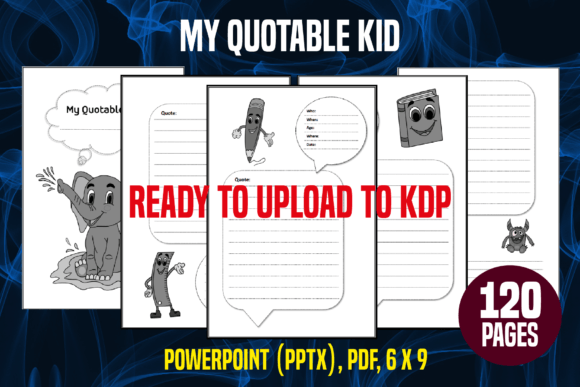
Behind the warm concept lies a concrete, production-tested set of files. When you receive the ZIP folder, you find two core components: an editable PowerPoint source file (PPTX) and a print-ready PDF interior. The PDF has been verified for Kindle Direct Publishing upload as well as standard at-home or professional printing, removing the guesswork that often frustrates first-time self-publishers. The trim size is set to 6 x 9 inches, a comfortable paperback format that feels substantial without being bulky. With 120 pages of high-resolution interior content, the journal gives families enough breathing room to record years of quotes while staying portable enough to tuck into a keepsake box or gift bag.
The inclusion of an editable source file is a quiet but significant advantage — and not only for those who wish to sell the finished product. A parent might add a child’s name to the cover or tweak a prompt before printing a one-off copy. A teacher or childcare provider could adapt page elements to fit a classroom memory project. A blogger or marketer could rebrand the interior with a complementary visual identity. In an era when customization is the silent expectation behind so many purchases, this flexibility turns a single purchase into a long-term asset.
Why a Dedicated Journal Makes Sense Right Now
The idea of recording a child’s funny sayings in a phone note or on a random scrap of paper is not new. What has shifted is an increasing desire for intentionality in how we store personal memories. Digital photo galleries feel infinite but oddly forgettable; voice memos get buried; social media timelines warp and compress genuine moments into performance. A physical journal asks for something different — a slower, more deliberate act of noticing. And because parents today are already stretched thin by work, caregiving, and endless digital noise, a structure that removes the burden of “What do I write?” has real appeal.
My Quotable Kid rides a broader wave of interest in analog memory-keeping that has grown quietly over the past decade. Bullet journaling, guided gratitude diaries, and one-line-a-day formats have proven that adults crave gentle constraints that encourage regular reflection without demanding too much time. Applying that same logic to the sweet chaos of parenting feels natural. The journal functions almost like a conversation partner: it holds the space, offers a prompt like “Who said it” and “Context,” and lets the quote itself become the centerpiece. No lengthy narratives required unless the user wants them.
The Quiet Rise of Low-Content Books in Everyday Life
For the creative and business-minded visitor to the store, there is another layer worth examining. The KDP-ready nature of this product reflects a significant publishing shift that has made niche journals, planners, and logbooks accessible to millions. During the past few years, low-content and medium-content books have carved out a permanent shelf in the marketplace, not because they are trendy, but because they solve specific, recurring needs. A parent searching for “kids quote journal” on Amazon wants exactly what this interior provides — no fluff, no overly complex layout, just a clean design that honors the words.
Entrepreneurs, freelancers, and small business owners who understand this shift can use a tested file like the one included in the store’s ZIP package to reduce product development time dramatically. Instead of learning interior formatting from scratch, spending hours on margin alignment, or troubleshooting upload rejections, they begin with a working file that has already passed through KDP’s checker. This allows them to focus on branding, cover design, and marketing — the activities that actually move copies. Even a blogger looking for a modest passive income stream or a side project can launch a quality product within days rather than months.
For Creators: What the Editable PowerPoint File Unlocks
Having worked directly with the provided source files, the practical implications are straightforward. The PPTX format is familiar to most users, requiring no expensive or niche software. Adjust a font, insert a small illustration, change a page number, or localize the language — each becomes a manageable task. Some customers may use the interior as a springboard for an entirely new series: a teacher’s edition with classroom-specific prompts, a grandparent edition with larger text, or a bilingual version serving a specific community. The file’s flexibility is not a promise of effortless profit, but rather a realistic toolkit that rewards effort with genuine control over the final output.
For those who simply want a beautiful personal copy, the same logic holds. You can print the PDF at home, bind it at a local shop, or upload to a print-on-demand service for a single high-quality volume. The high-resolution interior ensures that even small text and delicate line work reproduce cleanly, which matters enormously when the product is meant to be handled, reread, and shared over many years.
How Professionals and Educators Might Use the Journal
The store’s audience stretches beyond the parent sitting at the kitchen table. Early childhood educators, pediatric speech-language pathologists, and child therapists often look for ways to document language development or capture the authentic voice of a child in a respectful, celebratory format. A printable journal like My Quotable Kid can become part of a portfolio, a gift for a student’s family, or a closing ritual at the end of a school year. In these settings, the journal functions less as a passive record and more as an active tool for noticing growth and building connection.
Similarly, professional coaches and content creators who work in the parenting niche can incorporate the journal into their offerings. A sleep consultant might include it in a new-client welcome package. A family photographer could give a printed copy as a thank-you gift, reinforcing the idea that still images and spoken words belong together. These applications do not require massive scale; they thrive on sincerity and contextual fit.
Addressing the Realities of Time and Consistency
One of the most common objections to memory-keeping projects is the fear of starting something and never finishing it. A 120-page journal could feel daunting if approached as an all-or-nothing commitment. Yet the design of My Quotable Kid works with, not against, the erratic nature of parenting life. There is no daily requirement, no guilt-inducing date stamp. A user might fill two pages in a week when a child goes through a quotable burst, and then nothing for three months. The journal waits without judgment.
Realistic usage looks like a book kept on a nightstand or a kitchen shelf, pen tucked inside, ready for the moment when a 4-year-old announces that “the moon is made of tired cheese.” Those ten seconds of transcription become a bridge between the immediate joy and the future self who will read it years later and remember. That quiet, long-view orientation is what makes the product more than a novelty — it becomes a slow-built heirloom.
Market Trends and the Longevity of the Niche
The self-publishing ecosystem shows no signs of abandoning low-content books, and the reasons are structural. As print-on-demand technology improves, print quality rises while waste decreases. Consumers have grown accustomed to buying specialized journals for everything from wedding planning to pet memorials. The “kids quotes” category, while not new, benefits from the same evergreen demand that sustains baby memory books and milestone trackers. The advantage of a product like the one in the store is that its emotional core does not date — childhood is always happening somewhere, and parents will always want to slow it down.
For the store owner or anyone who adopts the interior for their own brand, this long-tail appeal matters. A seasonal spike around Mother’s Day or Christmas is likely, but so is steady baseline interest from gift-givers, new parent communities, and word-of-mouth sharing. The key is to present the journal not as a trendy impulse buy but as a timeless tool that can hold decades of family laughter.
Practical Recommendations for Getting the Most from the File
When you open the “Hi, welcome to the store” package and unzip the contents, a few immediate steps can set you up for success. If your goal is personal use, print a test page on your preferred paper to confirm ink absorption and feel. For KDP publishing, review Amazon’s current bleed and margin guidelines — even a tested interior benefits from a fresh visual check against the latest specifications. The PPTX file can be saved as a PDF after any changes, and many free tools can validate the final PDF before upload. If you plan to sell, consider bundling the journal with a small bonus, such as a digital quotes card or a short guide on how to interview children gently for richer material.
For those who have never created a print product before, this file lowers the technical barrier meaningfully. But it rewards attention to detail: choose a cover that resonates with the target parent demographic (soft colors, clean typography, maybe a playful illustration), write a description that speaks to the heart, and price competitively within the 6x9 journal category. The work remains, but the starting point is solid ground rather than quicksand.
Why We Pay Attention to a Child’s Words in the First Place
Stepping back from business applications, the staying power of a product like My Quotable Kid rests on a simple human truth: language is how children reveal their inner world, and that world is surprising, hilarious, and heartbreakingly temporary. A quote like “When I grow up, I want to be a rainbow” does not serve a utilitarian purpose. It serves something deeper — a reminder of innocence, a snapshot of a developmental stage, a piece of family identity. In a culture that habitually rushes toward the next milestone, the act of writing down those words is a small act of preservation and presence.
This journal does not promise to change parenting, boost productivity, or optimize anything. It promises a container. And in a time when so many products chase attention with grandiose claims, that modest promise feels refreshingly honest. Whether you visit the store to pick up a single printable for your own family or to acquire a publish-ready interior for a new business line, the invitation remains the same: notice the words, write them down, and hold them close. The high-resolution pages and the editable source file are simply the polite, well-prepared staff that make the whole experience possible without friction.
Thank you for visiting the store — the welcome is genuine, and the tools are ready.