Mastering Mental Labyrinths: Inside Hard Mazes for Advanced Puzzlers Vol-5
There is a distinct moment when a seasoned puzzle solver recognizes that simpler mazes no longer demand enough of their attention. The path from start to finish becomes almost automatic, and the brain craves a more intricate geography. This is precisely the terrain that Hard Mazes for Advanced Puzzlers Vol-5 occupies—a carefully crafted collection where the route is never obvious and the challenge demands genuine cognitive engagement. The volume does not aim to frustrate, but rather to invite the solver into a state of deep focus that many adults find increasingly scarce in a fragmented digital world.
Why Complexity Appeals to the Adult Mind
Mazes are often mischaracterized as children’s pastimes. Yet adults who turn to advanced labyrinthine puzzles discover an entirely different experience. In these pages, the brain encounters multiple branches and loops that force working memory to hold several hypothetical paths simultaneously. Each dead end is not a failure but a recalibration, requiring the solver to mentally rewind and reconsider earlier decisions. This iterative loop of hypothesis and feedback quietly strengthens executive functions, particularly planning and cognitive flexibility.
Researchers studying neuroplasticity have long noted that unfamiliar, complex visuospatial tasks stimulate the prefrontal cortex. Unlike routine mental exercises, an intricate maze on an 8.5x11 inch sheet of paper engages fine motor control as the eye traces potential routes, while simultaneously demanding a global overview of the pattern. The brain must switch between local detail and global structure—a skill that translates directly to project management, debugging code, or navigating city streets. In this sense, each of the 1000 puzzles inside Hard Mazes for Advanced Puzzlers Vol-5 functions as a micro-simulator for real-world problem-solving under constraint.
The Anatomy of an Advanced Maze
What makes a maze challenging for an adult? Superficial size is not the answer. A large but simple maze with a single winding path can be solved with patience alone. True difficulty emerges from structural features that subvert the solver’s usual heuristics. Among the most important are:
- Multiple branching intersections that force active elimination rather than passive line-following. The solver must consciously mark which paths have been explored and remember the outcomes.
- Closed loops that return the traveler to a previously visited point. These can induce a sense of déjà vu, testing whether the solver truly recognizes the location or merely assumes progress. The best loop traps exploit our tendency to overlook backward-facing connections.
- Obstacles or barriers that interrupt an otherwise viable corridor. These internal walls demand on-the-fly rerouting and often force a detour into an entirely different quadrant of the maze, disrupting the solver’s spatial momentum.
- Asymmetric designs where the visual center of the page does not align with the logical center of the puzzle. Our eyes naturally gravitate to the middle, but the solution may require spending most of the time in the periphery.
In Hard Mazes for Advanced Puzzlers Vol-5, these elements are not used gratuitously. Each maze is designed so that a solver who pays close attention will find a coherent logic, even if the path is surprising. The collection deliberately avoids the chaotic “pick the right corridor by luck” approach. Instead, it cultivates a sense of earned revelation: when the exit is finally reached, the entire twisting journey often snaps into a satisfying pattern that was hidden only by one’s own assumptions.
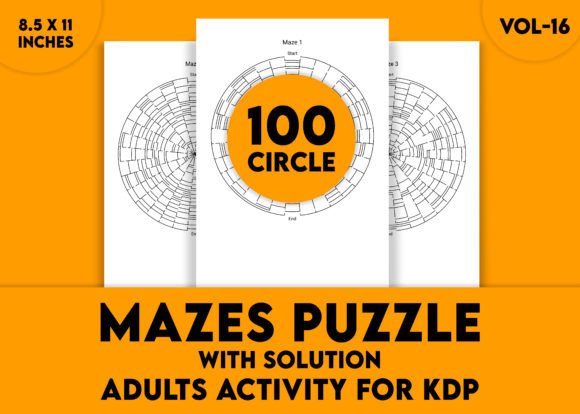
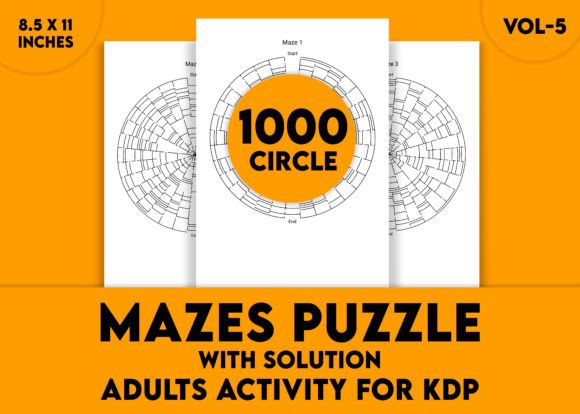
Because every puzzle occupies its own 8.5x11 inch page, the design never feels cramped. The generous 1 circle per page layout (referring to the distinctive circular maze format used in many of the puzzles) gives the solver room to work, allowing the eye to trace effortlessly without crossing into adjacent puzzles. This might seem like a minor production detail, but experienced puzzlers know how interference from neighboring images can break the immersive state. The clean page-per-puzzle design is an invitation to focus entirely on the single challenge in front of you.
The Tactile Advantage of Large-Format Paper
In an era of apps and screens, the deliberate choice to solve physical mazes on 8.5x11 inch paper deserves attention. The size is standard enough to be portable, yet large enough to allow for the miniature hand movements that accompany concentrated tracing. Many advanced solvers report that the physical act of running a finger or a pencil tip along potential routes creates a form of embodied cognition. The brain integrates the tactile feedback, and memory for paths already tried becomes stronger than when simply staring at a screen.
There is also a practical advantage for professionals and educators who use these puzzles in group settings. A standard sheet size allows for easy photocopying, sharing, or framing a completed maze as a small achievement. Occupational therapists often incorporate maze work into fine motor skill rehabilitation for adults recovering from hand injuries or neurological events. The large format provides sufficient space for controlled movements, and the complexity ensures that the exercise remains engaging rather than tediously simple.
Editable Flexibility for Creators and Educators
One of the most distinctive features of this volume is its availability as an editable PDF file. This moves Hard Mazes for Advanced Puzzlers Vol-5 beyond a static book into a flexible resource. A corporate trainer designing a team-building exercise can extract a single maze, enlarge it, or overlay custom instructions. A teacher working with advanced students can adapt the pages to create progressive difficulty sequences, or even combine elements of different mazes to generate new hybrid puzzles. The editable format respects the intelligence of the user—it treats the mazes not as precious, sealed artifacts but as materials intended for creative reuse.
For content creators and puzzle enthusiasts who run online communities or newsletters, the editable PDF unlocks possibilities that a bound book would not. Imagine a weekly puzzle challenge shared digitally, where the community discusses different solving strategies. Because the file can be manipulated, puzzles can be rotated, mirrored, or partially obscured to create fresh variations on a theme. The 4 solutions per page format also means that answer keys are neatly organized, making it simple to provide solution snippets without spoiling the entire page for those who want to attempt the puzzle first.
It is worth pausing on the solution design. Rather than providing a single tiny key, the layout groups four solution paths on one sheet. For a solver who has just finished a particularly difficult circular maze, checking the correct route becomes a learning opportunity. Comparing one’s own path with the intended solution reveals where the mind made early correct choices or fell into systematic biases (such as always veering right at ambiguous junctions). This reflective step transforms the maze from a one-time test into a tool for metacognitive growth.
Use Cases Across Different Audiences
The broad appeal of advanced mazes becomes clear when considering the diverse groups that benefit from them. While the immediate image is of a solitary enthusiast at a desk, the reality is far more varied.
- Professionals in high-stress fields—pilots, surgeons, software architects—often use visuospatial puzzles as a mental warm-up. The focused attention required by a difficult maze acts as a cognitive primer, sharpening the ability to hold complex spatial relationships in mind before demanding tasks. The 1000-maze volume provides a vast library for daily practice without repetition fatigue.
- Researchers studying human navigation can use standardized printed mazes as experimental stimuli. The consistent 8.5x11 format and known difficulty parameters make it possible to compare performance across participants or over time. Since the mazes are printed, they do not introduce confounding variables from screen glare, refresh rates, or device familiarity.
- Hobbyists and puzzle collectors appreciate the sheer numerical depth. With 1000 unique designs, the volume avoids the disappointment of a thin booklet that is exhausted over a weekend. This is a long-term companion—a slow burn project that might occupy a corner of the coffee table for months. The circular maze theme provides aesthetic cohesion, while the internal variations keep each page surprising.
- Educators in mathematics and geometry find mazes to be natural introductions to graph theory, algorithms, and topological thinking. A circular maze, in particular, can demonstrate how the shape of a space influences optimal pathfinding strategies. Students can physically prove that a maze is solvable, then trace their reasoning, making abstract concepts tangible.
- Business owners and team leaders sometimes incorporate puzzles into creative off-sites. Solving a maze collaboratively—where one person traces while another verbally guides—reveals communication patterns and the ability to translate visual information into language. The editable PDF means that a facilitator can print exactly enough copies for each participant without waste.
The Cognitive Endurance Built Through Loops and False Leads
A distinctive quality of high-difficulty mazes is the way they condition the solver to tolerate uncertainty. Many of the mazes in this volume contain multiple branches that do not resolve quickly. You might follow a promising corridor for several inches of paper travel, only to confront a barrier that turns you back. This is not poor design; it is deliberate training in persistence. Our digital habits often reward quick jumps and instant feedback, but a printed maze cannot be clicked through. It demands that you sit with the not-knowing, methodically eliminating options until the true route emerges.
This kind of sustained attention is increasingly recognized as a protective factor against cognitive decline. Longitudinal studies suggest that engaging in novel, mentally challenging activities—puzzles among them—is associated with a lower risk of dementia symptoms. The key word is novel. Repeating the same easy crosswords or number games provides diminishing returns because the brain automates the solutions. Hard Mazes for Advanced Puzzlers Vol-5 combats this by varying the structural logic across its 1000 puzzles. The solver never quite knows whether this particular maze will rely on clockwise spirals, interrupted radial paths, or a deceptive near-miss at the starting point. The brain must remain flexible, constantly updating its internal model of what the maze might do.
Integration into Daily Practice
For those who wish to weave advanced puzzling into a routine, the volume’s format supports several approaches. The one-circle-per-page layout means that a single puzzle can be completed in a short break—perhaps ten to twenty minutes for very hard designs. Some solvers place the open book on a lectern or stand to avoid neck strain during long sessions, a small ergonomic consideration that the 8.5x11 inch size facilitates perfectly. Others prefer to remove a single sheet and work on it away from the book, allowing the puzzle to travel in a bag for solving during a commute or in a park.
The 4 solutions per page arrangement also creates a natural rhythm: complete four puzzles, then flip to the corresponding solution sheet for review. This cadence builds gentle accountability. Rather than checking after every single maze (which can undercut perseverance), you commit to a small batch, then learn from any errors in one sitting. For competitive or timed practice, this batch size is particularly useful.
It should be noted that the editable PDF extends to the solution pages as well. A teacher might white-out the answer keys and redistribute them as blank challenge sheets for students to reconstruct the solution logic from scratch. The files can be imported into tablet annotation apps, allowing digital solvers to mark routes with a stylus while retaining the paper-like experience that the large format provides.
The Satisfaction of the Unsolvable—and Why These Are Solvable
A common pitfall in advanced puzzle design is creating mazes that are so convoluted they become guesswork. Solvability is a promise. Every maze in this volume has a verified continuous path from entry to exit. The challenge lies in finding it, not in whether it exists. For the solver, this guarantee transforms the emotional experience. You are not battling an arbitrary construction; you are deciphering a logic that the designer embedded. This distinction is psychologically significant. Frustration gives way to determination because you trust that careful analysis will succeed.
When you finally trace the correct route—perhaps after several attempts and a growing mental map of the maze’s regions—there is a palpable release. The intricate twists and turns that once seemed hostile now reveal their architectural necessity. Each loop and barrier makes sense as a necessary component of the overall shape. This moment of aesthetic appreciation after cognitive struggle is rare in daily life, and it explains why adults return to such puzzles again and again.
Selecting Your Challenges Within the Volume
With 1000 mazes, not every puzzle will be solved in sequence. Some solvers appreciate the randomness of flipping to an arbitrary page and confronting whatever complexity awaits. Others prefer to scan the maze briefly before committing, building an initial impression of its nature. Because the circular theme is consistent, comparisons between puzzles become natural: is this one more radial or more concentric? Does it favor straight lines masked by gentle curves? Such observations turn the volume into a kind of explorer’s map, where you learn to recognize design families.
For those using the editable PDF, the ability to print select pages transforms the experience further. You might pull ten particularly fiendish mazes for a weekend challenge, leaving the rest for later. Or you might create a curated booklet for a friend, selecting a progression from moderate to extreme difficulty. The file’s flexibility ensures that the volume is never exhausted—it can be recombined and revisited in countless ways.
Ultimately, Hard Mazes for Advanced Puzzlers Vol-5 stakes its claim in a space where digital convenience and tactile concentration intersect. It acknowledges that adult minds need rigorous, off-screen stimulation, and it provides a thousand distinct invitations to that state. The large 8.5x11 inch pages, the solvable complexity, the editable source files, and the quiet ritual of tracing a path from confusion to clarity all speak to a deep human desire: to face a challenge that respects our intelligence, rewards our persistence, and reminds us that not every problem yields to a quick scan and a swipe.